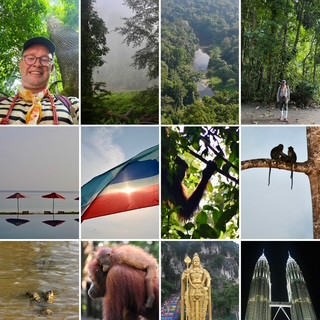
A family trip through Malaysia and Borneo, from Kuala Lumpur to Sandakan, Sepilok, the Kinabatangan River, Danum Valley and finally Gaya Island.
Some holidays help you switch off. Others make you look up, and Borneo was very much the second kind.
This blog was never meant to be a polished travel guide. It is a place to capture the journey as a family: what we saw, what surprised us, what made us laugh, what made us think, and whether stepping into rainforest, river and reef changed how we saw the world when we came home. More than anything, it is about the moments that stayed with us.
I remember, with real clarity, the moment we chose this adventure. We had two options in front of us: a more beach-and-sport trip to Costa Rica or the Borneo journey we eventually took. I had expected two teenagers to lean towards adventure with luxury and almost no challenge. To their absolute credit, they saw the lifetime moment that Malaysia and Borneo could offer us. The journey was a logistics challenge, but almost everything landed as it should. What we wanted when we came home was a sense of achievement and a set of memories, not just about animals, but about life, place and family.
Now, back in cooler air, I can reflect properly on what we saw and did, from the glass and heat of Kuala Lumpur to the sanctuaries, riverbanks, rainforest and finally the slower rhythm of Gaya Island.
Manchester to KL: leaving one world and arriving in another
The journey started with the familiar choreography of long-haul travel: bags, passports, security queues, airport food, tired excitement and the quiet calculation of whether anyone would sleep on the plane.
Our flight took us from Manchester to Doha and then on to Kuala Lumpur with Qatar Airways. Doha airport blew our minds and set the scene beautifully for what was to come: a rainforest in an airport, or at least that was the feeling it gave us.
The slightly disorganised experience of being pushed and shoved into the right queue at Manchester had gone by the time we reached Doha. There it was calm, clean and efficient, and we felt ourselves calming down before the second leg.
One thing we noticed about airports in 2026 was that the focus on retail had begun to squeeze out the need for decent food options. As we sat at Gordon Ramsay’s burger restaurant before heading towards our next flight, it all felt a little surreal.
From Kuala Lumpur airport, with its own mini rainforest inside too, we were transferred across the city to The RuMa Hotel, our base for the first two nights.
Even that first drive offered something to notice, including a sign telling us exactly how far it was to spot the mythical creatures of Japan, China, Denmark, Scotland and the USA: 12,929 kilometres away. That made me giggle. The hotel dazzled us immediately: a brilliant location and awesome views of the Petronas Towers. To beat the time-zone difference, we refreshed ourselves and went straight out to KLCC Park for the obligatory night photos.
The towers were beautiful, framed by dancing fountains and visible from more angles than we could possibly photograph before heading into Suria KLCC, a shopping mall with a difference. I do not think the two smaller ones could quite believe their eyes, or their luck, with such shopping temptation on the doorstep.
Kuala Lumpur: heat, height and first impressions
The next day, Kuala Lumpur became much more than an arrival point. It was a place of contrasts: the Petronas Twin Towers rising cleanly above the skyline, colonial buildings, Chinatown, Little India, the National Mosque, food markets, new roads, old streets and the heavy tropical air that immediately reminded us the UK was a long way away.
Our Kuala Lumpur City Tour included half a day at the Batu Caves. The immediate shock and awe came from the scale of the Hindu monuments, set against the chaos of monkeys after anything they could get their hands on.
Climbing the 272 steps to the main cave temple and the statue of Lord Murugan was always going to be a challenge for me, having hurt my knee earlier in the month. Going up was far easier than coming down.
What stayed with me, though, was how much temple life carried on all around the tourists taking photos and trying to understand. Offerings were for sale everywhere, from chains of carnations to live chickens and aromatic incense. Not for the last time, we also felt the slightly awkward western-ness of taking our shoes off before entering a sacred space.
Hinduism has always fascinated me, and Batu Caves gave us a vivid glimpse of how story, devotion and place sit together. That sense of connectedness would echo through the next two weeks.
By the time we got back to the bottom, having negotiated the monkeys again, we felt ready for some non-laziness rest too.
Back in our transport, we took in more of the city and its history, including the King’s Palace, National Mosque, National Monument and Sultan Abdul Samad Building. Each stop gave Sam, our guide, a chance to explain more about Malaysia.
The way Malaysia chooses its head of state particularly struck me. The Yang di-Pertuan Agong is elected for a five-year term from among the rulers of the nine Malay states with hereditary monarchies. Compared with the churn, noise and performative drama of UK politics right now, there was something striking about a transition of national leadership that appeared so orderly, ceremonial and calm.
Sam listened carefully to what else we wanted to see and adjusted the plan on the hoof. He gave us space to think about Malaysia while still delivering the fun we wanted too.
That included Jamboo Café, which felt designed for exactly this kind of family detour: big colours, bigger drinks, an Instagram-famous wall of options and the slightly bonkers theatre of a monster hand delivering the chosen order. It was ridiculous in the best possible way, and exactly the sort of stop that makes teenagers forgive you for the history and culture bit of a city tour. From there we went to BookXcess at REXKL, which was less a bookshop and more an adult climbing frame built from bookshelves, all tucked inside a former cinema full of art, culture shops and brilliant photo opportunities. I could have stayed there for hours, wandering up and down through books, concrete, colour and old-building character. Kuala Lumpur kept doing that to us: one minute temples and national monuments, the next a drink delivered by a monster hand and a bookshop that felt like a secret world.
The city felt like a beginning rather than a stopover. It should perhaps have been a destination in its own right. As we collected our purchases, packed for the morning and squeezed in a rooftop swim, we realised we probably should have spent more time there. “We will be back” was the consensus.
Sandakan and Sepilok: conservation becomes personal
From Kuala Lumpur, the trip turned decisively towards Borneo. We flew with Malaysia Airlines from Kuala Lumpur International to Sandakan Airport, then transferred to Sepilok Forest Edge Resort near Sandakan.
It had been billed as basic and as an introduction to lodge living, but it was anything but basic. Our balcony looked down to a stream and up into the jungle. What we thought then was a full canopy experience, we would later learn, was only the beginning.
Testing the telephoto lens and binoculars on arrival, we immediately spotted the biggest lizard I had ever seen swimming in the stream, monkeys in the trees and flying squirrels getting ready for dusk.
This first stop gave us our first proper rainforest moment. The view from the main lodge area helped us understand the height of the canopy and the feeling of looking across a living green system rather than simply walking through trees. It was the point where the trip became less about seeing places and more about being inside an ecosystem unlike anything we had witnessed before.
The food at Sepilok Forest Edge felt like a deep dive into the days ahead: a fried noodle station delivering a fresh and immediate taste of Malaysia, all prepared with almost comic, frantic energy. Heavy rain stopped the planned night-time wander into the jungle, but we still felt we had taken our first dip into the life we were about to borrow for a few days.
Sepilok Orangutan Rehabilitation Centre and the Bornean Sun Bear Conservation Centre were the first major wildlife stops of this adventure, and certainly where we came face to face with the stars of the show.
Sitting side by side, both centres made rescue, rehabilitation, habitat loss and human impact visible, but in a way that felt immediate rather than abstract.
At Sepilok, the feeding platform and outdoor nursery gave us a chance to observe orangutans learning, climbing, feeding and moving through the forest. At one point, walking through the jungle, we were quietly asked to stand still. We all did!
Then a mother orangutan, with her baby wrapped around her, simply ambled along the handrail of the walkway. As introductions go, it was perfection, and it made the whole idea of conservation feel suddenly very personal.
At the Bornean Sun Bear Conservation Centre, the story shifted to the world’s smallest bears and a less widely known conservation challenge. We had been warned that we might not see the bears at all, but there they were, arriving for elevenses and showing off their unique colouring, huge claws and Paddington-like faces. Magical.
There was also a shout-out for the rhinoceros hornbill, spotted in the canopy. It is an iconic bird of Borneo and the state bird of Sarawak, and it was firmly on our must-see list. Less than a day into the Borneo wildlife part of the adventure, we had seen bears, orangutans and a rhinoceros hornbill. The trip had started to make good on its promise very quickly.
Kinabatangan River: the slow theatre of wildlife
After the intensity of Sepilok, the Kinabatangan River changed the pace. We travelled by road from Sandakan to Sukau, then continued by boat from a beautiful jetty to Sukau Rainforest Lodge. The jetty was part garden centre, part local market and part working river stop, where vast and slightly terrifying fish were landed ready for local kitchens.
Even the transfer felt like part of the experience, but now the journey had become slower, quieter and more watchful.
Sukau Rainforest Lodge became our base for two nights. It was more comfortable than I had expected, but still close enough to the river and forest to feel wonderfully exposed to the place. Abas, our constant eyes and ears on the river, was brilliant from the start.
On arrival, large troops of long-tailed macaques were moving through in packs, giving the lodge an immediate, slightly chaotic wildlife energy.
Our river safaris weren’t about chasing wildlife. They were about allowing the river to reveal itself: a branch that became a bird, a rustle that became a monkey, a shadow that might become something larger, and the collective silence that fell across the boat when everyone was looking in the same direction.
Abas seemed determined that we would see the river through his eyes. His knowledge was extraordinary, almost as if a stage show was being revealed one scene at a time.
The first night cruise set off with no promise of anything, although Abas’s wry smile suggested he knew better. Estuarine crocodiles were high on the river wish list, and he spotted three on that first cruise. One in particular came close enough to check us out, give us the eye and provide the full danger-on-the-river photograph of his three-metre majesty.
It was amazing, and probably one of those moments I will never forget.
One of my best memories was the early-morning river trip to Pitas Oxbow Lake. At half past six, ten tourists huddled around Abas as he briefed us on what we might see. The boat moved upriver at a leisurely pace rather than flying along as it had on other trips. We had to duck under overhanging trees before arriving in a huge lake, slowly being consumed by vegetation and changing almost every day.
We saw proboscis monkeys properly in daylight, having only really seen their shadows up to that point. Along the way we caught sight again of orangutans and rhinoceros hornbills, which by now felt almost famous to us.
The photos and videos made the place look like a film set. Not the polished Universal Studios version, but something far closer to Indiana Jones and the Temple of Doom.
Then, on our last day on the river, the rain came. And boy, did it arrive. There were power outages and what we would have described back home as biblical rainfall. We were debating whether to risk the final cruise when Abas came running up, his usual “Miss Sarah” almost becoming one long word.
Bornean pygmy elephants had been spotted upriver, and the instruction was simple: get a waterproof and get in the boat. Now.
The boat flew faster than I thought it could. Then, as we rounded a corner, the engines were cut and we drifted towards the shore.
The grasses were moving. Birds were taking off. Then a baby elephant flopped into sight. We thought that was it, but this little Dumbo had arrived to give us a show: wallowing in the mud, trumpeting with joy and wobbling all over with happiness. How do elephants create such joy in humans?
As I looked around the boat, all of us were in tears as this amazing creature showed us his habitat and absolute confidence in his natural environment.
And then we were off again, leaving the river behind and heading deeper into the green.
Danum Valley: entering the deep green
The move from Kinabatangan to Danum Valley felt like a deepening of the journey in every sense. The route took us from Sukau by road to Lahad Datu, where we checked in at the Borneo Rainforest Lodge office before switching into an off-road 4×4 for the drive into the Danum Valley Conservation Area.
Borneo Rainforest Lodge was to become our base for three nights, with the possibility of hearing gibbons before seeing anything at all.
Danum Valley wasn’t just a backdrop for adventure. It asked us to pay attention. If the river had taught us to watch and wait, Danum asked us to look up, look closer and accept that we were tiny inside something much older than us.
Each activity could have been a scene in its own right, but the deeper story was scale: the height of the trees, the age of the rainforest, and the way family conversations changed when there was no signal and the soundtrack was insects, water and birds.
Borneo Rainforest Lodge more than lived up to the dream that had been painted beforehand: absolute luxury, yet properly in the heart of the jungle.
The journey in by car was spectacular. We weren’t shy about asking for photo stops because the valley below, as we climbed higher and higher, was like nothing I had ever seen before. The descent into that same valley began to feel like a rollercoaster ride at times. We went around the last corner and there, in front of us, was our lodge for the next few days. The lodge was spectacular, but what mattered even more was the family of red monkeys that had decided this was the perfect time to greet the humans arriving at their home.
The big hike was far harder than expected, so it is worth knowing exactly what you are signing up for. Leech socks were a must, and thankfully Abas had warned us early enough for the family to buy some in advance. None of us quite worked out why we thought our first solo walk without our guide was the right moment to go beach-ready. Gill, our guide for the duration, had suggested we go and acclimatise. There was a little platform path where we could get a feel for the jungle, so after the long journey we changed into something comfortable and headed out. Gill was not impressed when we got back and explained that we had ventured into the jungle in flip-flops, shorts and T-shirts, and somehow survived.
Gill, our guide at the Rainforest Lodge, was brilliant with the small ones. He pushed us hard on the activities, but we got so much out of them. Coffin Cliff became one of the most powerful moments of Danum Valley. It linked back, unexpectedly, to Batu Caves in Kuala Lumpur, where the 272 steps had already tested my knee. Coffin Cliff was a different kind of climb: less neatly laid out and much more elemental.
It began as a jungle trail and became progressively steeper, with humidity, mud, tree roots and uneven ground making each section feel harder than the distance suggested. Near the top, ropes helped with the steepest parts.
We slowed down, took breathers, watched our footing and realised that the effort was part of the meaning of the place.
The site is associated with local burial traditions, with wooden coffins placed high in the limestone cliff. We had recently visited the Catacombs of Rome, so the contrast struck me hard. There, the dead were buried deep beneath the city. Here, they had been carried high above the rainforest. Two completely different ways of showing respect, remembrance and closeness to the beliefs of the people living there.
Standing there, hot, muddy and breathless, it felt less like arriving at a viewpoint and more like arriving somewhere sacred.
Gaya Island: reef, rest and letting the journey catch up
After the rainforest, Gaya Island felt like a deliberate exhale, giving us space to let the journey catch up with us.
The transfer took us from Borneo Rainforest Lodge back to Lahad Datu Airport, then by Malaysia Airlines to Kota Kinabalu Airport. Lahad Datu Airport was a moment in time for us: small, authentic and wonderfully modest after the larger airports we had passed through. There was a DIY bag scan, a departure board that was basically a computer screen attached to a laptop, and a bag-weighing belt that ended, quite literally, in a hole in the wall, where a chap appeared and carried our precious bags towards the back of the plane.
From Kota Kinabalu we were whisked through the city to Jesselton Point and then travelled by speedboat to Gaya Island and the Bungaraya Island Resort, where we were to stay for three nights.
The only nervous logistics moment of the whole trip came at the boat terminal, where the timing and passenger details seemed not quite right at first. It was sorted, so it didn’t become a problem. It did, though, make us pause and think how lucky we had been to have all of the logistics simply work at every other junction.
The island felt like a reward, a contrast and a continuation of the nature theme.
Bungaraya is in a beautiful location, with spectacular views, a lovely beach and a strong sense of place. It was a great final stop, although the resort felt tired in places, which distracted a little from the luxury of where we were, but not enough to spoil it.
The food was superb. Service was slow, but delivered with real care and attention. The views, pool, beach and simple significance of being there stood up strongly against what we had seen over the previous ten days.
More importantly, Gaya gave us something we hadn’t really had since leaving Manchester: time to stop.
A family kayaking trip was so much fun. The one sport I was ever really any good at as a teenager was canoeing in Nottingham, so I felt quite smug speeding off out to sea, all four of us soaking up the sun. We joined the boats together once we were quite deep, and the small ones jumped in to snorkel and see every colour of fish you could imagine. After days spent looking into trees, scanning riverbanks, climbing through rainforest and waiting for animals to appear, we could finally sit beside the sea and stop for a while.
What comes home with us?
And then we were on our way home. The journey wasn’t quite in reverse, but it still meant three flights and, eventually, Manchester.
So what were the images we all left with?
An orangutan hand around a branch. One of the small ones on a boat scanning the riverbank. The green dark of Danum. The first view of the sea at Gaya Island. The whole gang of us with damp shoes and even damper clothes after the hike.
It was impossible to pick one image, which is probably why we ended up playing the top-five-things-that-surprised-us game over dinner on our final night.
Mine were Kuala Lumpur itself, with its history and modern energy; the emotion I felt seeing so many of the animals; the effort of the hike and the reward of doing it; the quality of time together; and, finally, the reminder of just how big the world is.
Did Borneo change our understanding of that world? Yes, I think it did.
It reminded us of the fragility of nature and the privilege of being allowed to witness it. To see orangutans, hornbills, crocodiles and elephants in places that belonged to them was not just a memory to collect; it was a reminder that conservation only becomes real when you understand what could be lost.
We went to Malaysia expecting to see extraordinary things: orangutans, crocodiles, hornbills, elephants, rainforest, rivers and reefs. And we did see all of this. But the real gift was quieter than that. It was the way the trip made us pay attention: to movement in the trees, to the patience of guides, to another culture, to tired legs on a climb, and to the joy of being together without too many distractions.
That is what came home with us. Not just the photos, although there were plenty of those. Not just the stories, although we will be telling them for years. What came home was the reminder that the best journeys do not simply show you new places; they alter the way you notice the place you return to.
Some holidays help you switch off. The best ones teach you to look up, notice more, and come home with a little more responsibility for the world you have been lucky enough to see.
So, when did a journey last make you look up? I recommend adding that to the criteria next time you are planning a break away.